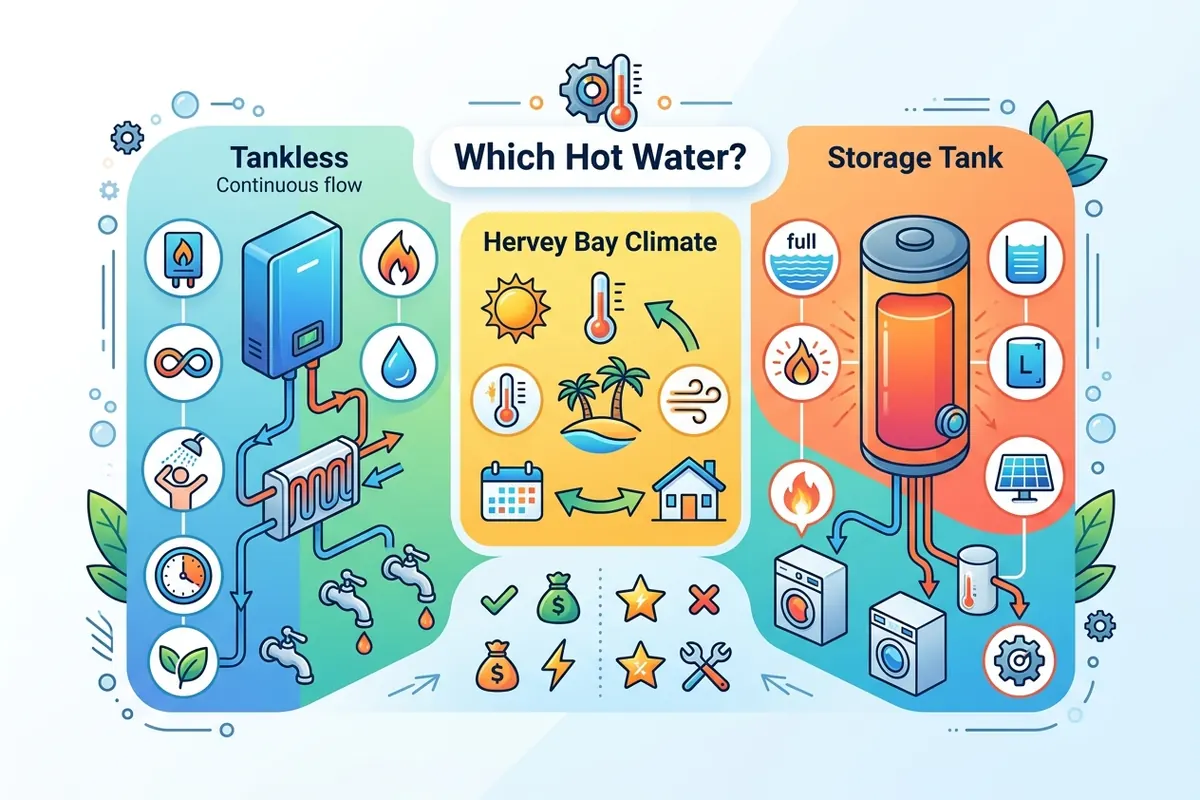
Tankless (also called instant or continuous flow) hot water heaters got a big push in the last decade. The pitch is energy efficiency and endless hot water. The reality in Hervey Bay is a bit more nuanced.
How they work
Tankless units fire up when you open a hot tap. Water flows through a heat exchanger and gets heated on demand. Storage tanks keep 200-400 litres of water hot all the time, ready to use.
Where tankless wins
Lower running cost if you use hot water in short bursts spread through the day. No standing heat loss because there's no tank to keep warm. Smaller footprint, often mounted on a wall outside.
Endless hot water. Two long showers back to back doesn't drain the tank. For a family with teenagers, this matters.
Where storage wins
Cheaper to install. A like-for-like storage replacement is $1,400-$2,000. A tankless replacement is often $1,900-$2,800.
Better with solar panels. You can run the heating element during the day when solar is generating and store hot water for evening use. Tankless units fire up when you turn the tap, regardless of whether your panels are producing.
Recovers faster after a power outage. After cyclone-season blackouts, a storage tank still has hot water for hours. A tankless unit gives you cold water until power's back.
What suits Hervey Bay homes
If you've got solar panels: storage every time. A storage tank running on solar excess is the cheapest hot water you'll ever have.
If you don't have solar but you've got gas: tankless gas is great. Compact, efficient, and the rebates help with install cost.
If you're on grid electric and don't have solar: a modern heat pump (which uses a storage tank) is the best of both worlds. Low running cost like tankless, store-and-use simplicity like a tank.
What we usually recommend
For 80% of Hervey Bay homes built in the last 15 years, a heat pump on a storage tank is the right call. It's not as exciting as tankless but it's cheaper to run, simpler to maintain, and works with solar.